Professor, Psychology & Communication Sciences and Disorders (courtesy)
Northwestern University
Head of the Brain, Behavior and Cognition Program at NU Psych
Link to Faculty page at Northwestern University Psychology Department
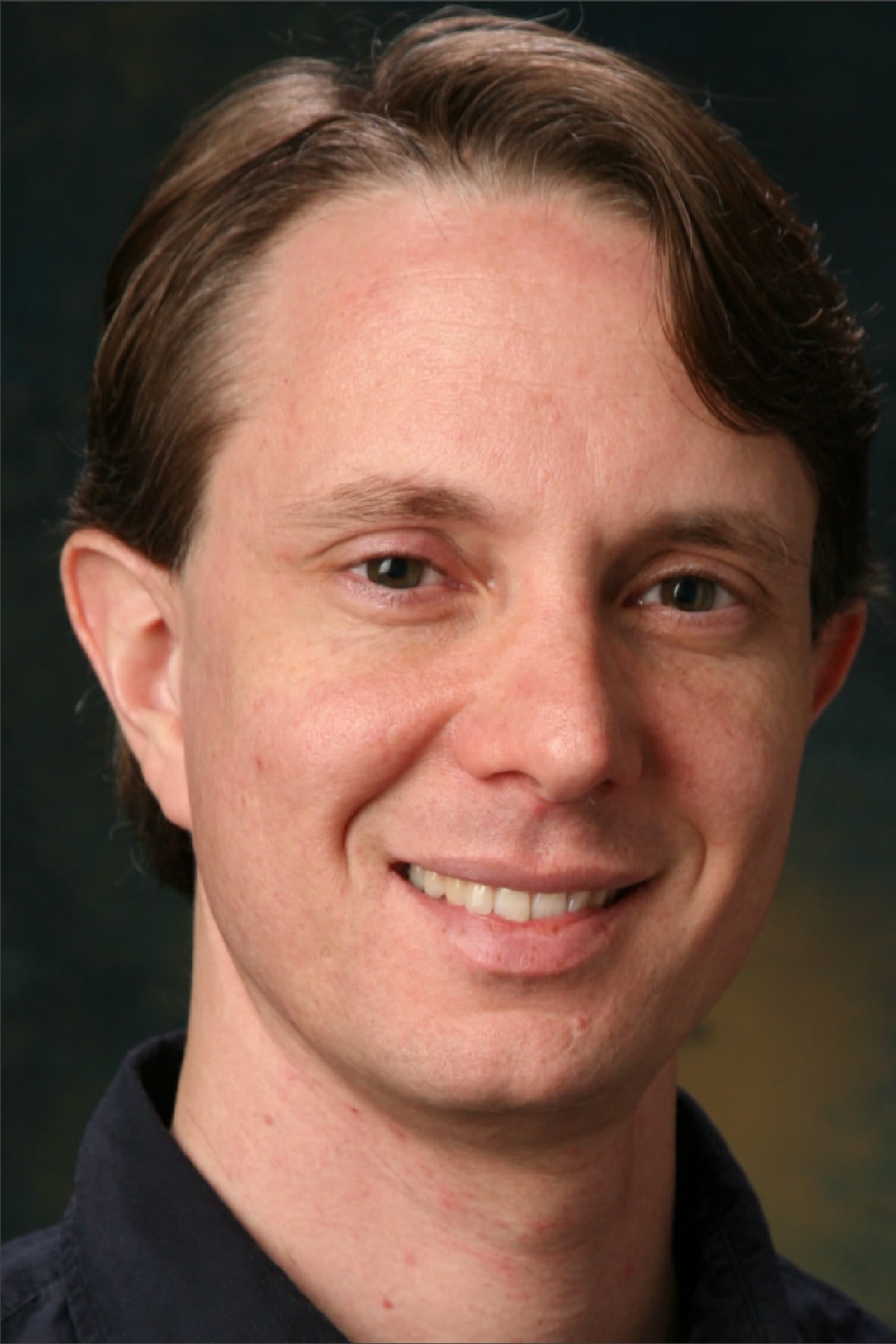
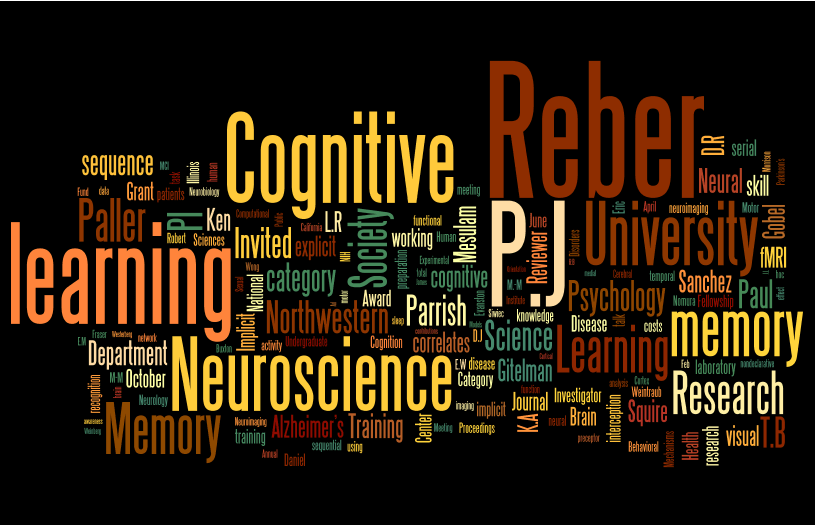
A Wordle based on my current CV (Aug 2011) which seems like a surprisingly good snapshot.
Professional interests
My research focuses primarily on memory throughout the human brain, particularly the cognitive neuroscience of implicit memory and skill learning. In my laboratory, we study memory phenomena with traditional experimental psychology methods, applied methods in the field, functional neuroimaging and neuropsychological studies of patients with learning or memory disorders such as Alzheimer’s and Parkinson’s disease. Over the past 20 years, we have extensively examined the neurocognitive basis of human visual category learning, skilled expertise, and the operation of the multiple brain systems that support different types of learning. This work is largely guided by a multiple-memory systems framework currently implemented as a cognitive model, PINNACLE, which captures the both the simultaneous parallel operation of explicit (conscious) and implicit (nonconscious) learning and the interactions between these systems in the development and expression of expert performance.
Increasingly, our research has aimed to translate results in the basic science of learning and memory to practical applications outside the laboratory. The cognitive neuroscience of implicit learning is being used to guide improvements in training procedures aimed at the rapid development of skilled performance (map understanding) and intuition (two projects funded by the Office of Naval Research). New projects involve the development of tools for monitoring cognitive change over time in aging and a preliminary examination of stress and emotional control in elite videogame competitors. Recent collaborative projects have examined memory function and manipulation during sleep (with Ken Paller, supported by DARPA) and applied cybersecurity using implicit learning to train nonverbalizeable passwords. In each of these applied implicit learning approaches, the often-underappreciated influences of the neural consequences of implicit learning are directed towards improvements in cognitive ability based on principles derived from our basic science laboratory research.
Professional Experience
| Sept. 1998-Present | Professor of Psychology & Communication Sciences and Disorders, Northwestern University Fellow, Cognitive Neurology and Alzheimer’s Disease Center, Northwestern University Medical School. Member, Northwestern University Institute for Neuroscience |
| 1997-1998 | Cognitive Neuroscience Research Fellow, Magnetic Resonance Institute & Department of Psychiatry, University of California at San Diego. |
| 1993-1997 | Post-doctoral fellow with Larry R. Squire, Ph.D., Department of Psychiatry University of California at San Diego. |
Education
| 1989-1993 | Ph.D. in Cognitive Psychology, Carnegie Mellon University, Department of Psychology |
| 1984‑1988 | B.S. Eng in Computer Science, University of Pennsylvania, Moore School of Electrical Engineering |
Professional Activities
- Head of the Psychology Department Brain Behavior and Cognition program, 2009-present
- Institute for Public Health and Medicine, 2012-present
- Beuhler Center for Aging and Center for Behavior and Health
- Member, Center for Behavioral Intervention Technologies, 2012-present
- Member, Northwestern University Interdepartmental Neuroscience program, 1998- present
- Associate Editor, Cortex, 2015-
- NIH Reviewer, Fellowships Review Panel (F02B, Standing member since 2013, Chair since 2015), SBIR Review Panel (July 2013), Adult Psychopathology and Disorders of Aging (ad hoc), June 2012
- NSF Cognitive Neuroscience Program Ad Hoc Reviewer
A usually out-of-date list of publications is available here
PJR May 2016